
EcoFlow Delta vs River: Practical Comparison to Choose the Battery You Really Need (Without Overspending)
EcoFlow Delta vs River comparison: power, portability, and price. Practical guide to choose the right battery without overspending. Find out which is for you!
Introduction
Have you run out of power at the worst possible moment? Whether for a road trip, a home emergency, or a solar installation project, choosing between EcoFlow Delta and River batteries can be a headache. It's not about buying the most expensive one, but the one that truly fits your consumption. At Zirian, we help you decode the key differences so you make a smart decision without overspending.
“The best battery is not the most powerful, but the one that perfectly fits your lifestyle and energy needs.”
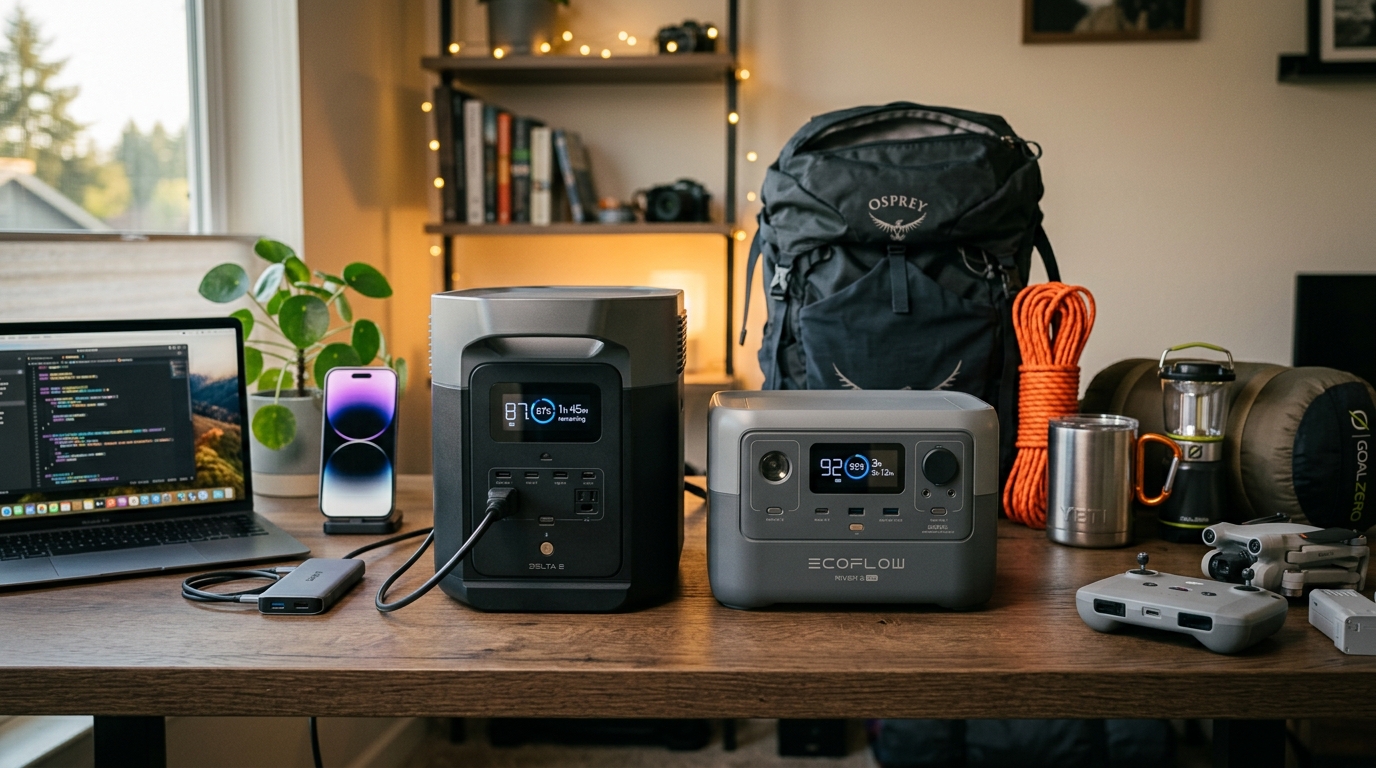
First, let's understand the basics: the EcoFlow Delta series is designed for users who need high power and large capacity, ideal for powering large appliances, power tools, or even serving as a whole-home backup for hours. On the other hand, the River series is the portable, lightweight option, perfect for camping, hiking, or keeping your mobile devices charged anywhere. The decision is not just about price, but about usage.
If your priority is mobility and you only need to charge laptops, drones, cameras, or small portable fridges, an EcoFlow River (like the River 2 or River 2 Pro) will be more than enough. But if you plan to connect a microwave, a washing machine, or several devices at once, then a Delta (like the Delta 2 or Delta Max) is the right choice. Let's dive into the specs so you don't make a mistake.
Quick Comparison: EcoFlow Delta vs River
To help you visualize the differences, here's a summary table with the most popular models from each series:
- EcoFlow Delta 2: 1024Wh capacity, 1800W output (3600W peak), fast charging in 80 minutes, 12 kg weight. Ideal for homes and heavy work.
- EcoFlow Delta Max: Expandable capacity up to 6kWh, 2400W output, perfect for full backup or more ambitious solar installations.
- EcoFlow River 2: 256Wh capacity, 300W output (600W peak), only 3.5 kg, charges in 60 minutes. Light and easy to carry.
- EcoFlow River 2 Pro: 768Wh capacity, 800W output (1600W peak), 7.8 kg weight. A balance between portability and power.
How much power do you really need?
The key is to calculate the consumption of the devices you'll use. For example, a laptop consumes around 60W, a portable fridge 50W, a drill 500W, and a microwave 1000W. With the River series (300-800W) you can cover the first two. With the Delta series (1800-2400W) you can connect the last ones without issue. Ask yourself: what are you going to plug in? If the answer is 'everything', Delta is your choice.
Portability: Does weight and size matter?
If you'll be moving the battery constantly (hiking, fairs, outdoor work), weight is critical. A River 2 (3.5 kg) fits in a backpack and you can carry it effortlessly. A Delta 2 (12 kg) is heavier, but still has a carrying handle. For fixed installations (like at home or an office), weight is not a problem. At Zirian, we recommend River for digital nomads and Delta for professionals or families.
Solar charging options: both are compatible
One of the great advantages of EcoFlow is compatibility with solar panels. Both Delta and River allow solar input, but charging speed varies. Delta supports up to 500W solar input, while River is limited to 110W (on the basic model) or 220W (on the Pro). If your solar installation is large, Delta is more efficient. If you only want portable panels for emergencies, River is sufficient.
Price: Which offers the best value for money?
The River 2 costs around $200, the River 2 Pro $500, the Delta 2 $700, and the Delta Max $1500. If you only need to charge a phone and a tablet, buying a Delta is wasteful. But if you need to power a drill or a microwave, a River will fall short and you'll have to return it. Value for money is achieved by choosing the model that fits 80% of your daily uses, not 100% of your desires.
Final tips from Zirian
Our advice: make a list of your appliances and their watts. Calculate the total and multiply by the hours of use. That number will tell you the minimum capacity you need. If you're undecided, visit our website or contact us; at Zirian we integrate energy solutions with personalized advice. Don't buy a battery 'just in case', buy the one that gives you peace of mind.